
The real question isn’t why quartz is everywhere.
It’s why serious commercial projects refuse to build without it.
Airports. Hotels. Hospitals. Corporate offices. Retail chains.
When spaces operate at scale, surfaces stop being decorative choices—and start becoming operational decisions. That’s exactly where Quartz Stone Countertops have earned their place. At Triqua Quartz, we don’t see quartz as just a material. We see it as infrastructure—engineered to support performance, hygiene, longevity, and brand experience in high-traffic commercial environments. This article breaks down why quartz has become the backbone of large-scale commercial applications, and what forward-looking projects must consider when choosing surfaces today.
Commercial Spaces Demand More Than Aesthetics
In residential design, surfaces are judged by beauty.
In commercial design, surfaces are judged by failure points.
- Will it stain under daily use?
- Will it crack under load and vibration?
- Will it age unevenly across hundreds of square meters?
- Will maintenance disrupt operations?
- Will hygiene standards hold up over time?
Natural stones often struggle here—not because they lack beauty, but because they weren’t engineered for scale.
1. Engineered Consistency Is Non-Negotiable at Scale
Large commercial projects don’t install one countertop.
They install hundreds—sometimes thousands—of square meters across locations.
Consistency isn’t a preference. It’s a requirement.
Quartz delivers:
- Uniform color and veining across batches
- Predictable thickness and density
- Zero surprises between sample approval and final installation
At Triqua Quartz, every slab is engineered under controlled conditions, ensuring visual and structural consistency from the first shipment to the last.
This is why quartz works where natural stone often fails:
scale exposes inconsistency—and quartz eliminates it.
2. Hygiene Is No Longer a Feature. It’s a Baseline.
Commercial environments today operate under intense scrutiny—especially healthcare, hospitality, food service, and retail.
Quartz is non-porous by design.
That single characteristic changes everything.
It means:
- No absorption of liquids
- No breeding ground for bacteria
- No mold or mildew penetration
- No need for sealing or resealing cycles
In environments where downtime costs money and hygiene affects trust, Quartz Stone Countertops quietly become one of the most reliable risk-management tools.
This is not about convenience.
This is about compliance, reputation, and uninterrupted operations.
3. Durability That Matches Commercial Wear Cycles
Commercial spaces don’t experience “use.”
They experience continuous load.
Quartz performs because it’s built for that reality:
- High resistance to scratches and abrasion
- Structural strength against impact and heavy fixtures
- Stability under temperature variation
- Long lifecycle with minimal degradation
At Triqua, durability isn’t tested in isolation.
It’s tested against real commercial conditions—foot traffic, cleaning chemicals, equipment movement, and daily stress.
A surface that needs replacement every few years isn’t a premium surface.
It’s a hidden cost.
4. Maintenance Economics Matter More Than Material Cost
Here’s an uncomfortable truth many projects learn late:
- The cheapest surface upfront often becomes the most expensive surface long-term.
- Quartz changes the math.
- No sealing contracts
- No specialized cleaners
- No frequent refinishing
- No operational shutdowns for upkeep
For multi-location brands and large facilities, this translates into:
- Lower lifecycle cost
- Predictable maintenance budgets
- Fewer operational disruptions
Quartz doesn’t just save money—it protects operational continuity.
5. Design Flexibility Without Operational Compromise
Commercial architecture today must balance brand identity with function.
Quartz enables that balance:
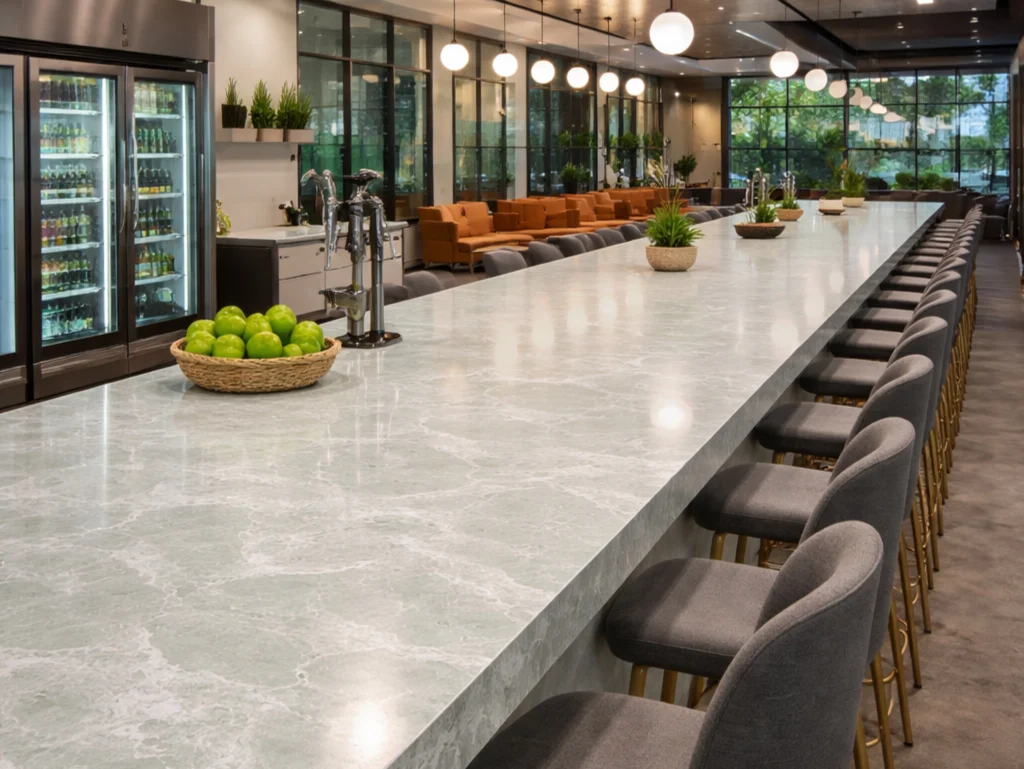
- Marble-inspired aesthetics without fragility
- Minimalist, monolithic surfaces for modern spaces
- Large-format slabs that reduce joints and visual clutter
- Custom finishes aligned with brand palettes
At Triqua Quartz, we design surfaces not just to look premium—but to stay premium under pressure. Because in commercial environments, beauty that degrades quickly damages brand perception.
Triqua’s Perspective: Quartz as Commercial Infrastructure
Our vision at Triqua is simple:
Quartz is no longer a finished material.
It is part of a building’s operating system.
That’s why we focus on:
- Engineering precision, not just aesthetics
- Batch consistency, not one-off beauty
- Scalable supply, not limited availability
- Global standards, not local shortcuts
We work with partners who understand that large-scale projects succeed when materials are predictable, resilient, and designed for the long term.
Where Commercial Design Is Headed Next
Looking ahead, the demand for quartz in commercial spaces will only accelerate—driven by:
- Stricter hygiene regulations
- Faster project timelines
- Higher expectations of durability
- Greater emphasis on lifecycle cost
- Consistent brand experience across locations
- Materials that can’t scale—technically or operationally—will be left behind.
- Quartz won’t.
Final Thought
Quartz Stone Countertops didn’t become the standard for large-scale commercial applications by trend. They earned it by performance.
At Triqua Quartz, we believe the future of commercial design belongs to materials that work silently in the background—supporting operations, protecting brands, and lasting far beyond the initial install.
That’s the role quartz now plays.
And that’s the standard we build toward every day.